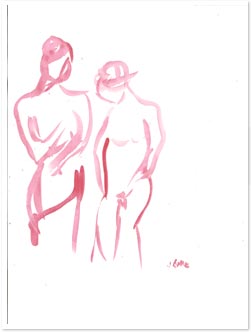
There is no doubt that Jacques SELLE owes his rare ability to love beauty and transpose it into his painting to the fact that he was born in Fécamp.
These paintings are not only admirable: they assert a vitality and quality rarely seen in an artist, even a talented one.
His spaces are nothing but sumptuous displays of dynamic elements that are depicted with varying degrees of surrealism.
Brilliance and drama clash with stunning or tumultuous elegance within a strictly limited range of colours.
The overwhelming warm consonances are more down to earth, along with some of his cycles that are almost infernal in nature, and yet they always possess an extraordinary textured quality.
In this way, the poetry, love, and life are released by the artist‘s magic.
The eye is compelled to accept the impossible in a daring genesis created in this artist who travels afar in his mind’s eye.
He maintains a generous harmony, even when he devotes himself with superb to the delectable game of collage.
This is how Jacques SELLE manages to purposefully evoke spaces, beings, and places, while remaining completely devoted to the rhythm at all times.
He even introduces a purposeful sensuality, leaving us confounded.
André Ruellan
Art critic
Moving spaces
Between lyrical abstraction and free representation, the universe of Jacques Selle (…) explores space, man’s inner life, and alternates between vaporous abstraction and (…) singular portraits, oft-times caricature-like.(…)
Much travelled – the Andes Cordillera and the Tierra del Fuego - , (…) he has imbibed what he found, causing to be reborn on canvas or paper impressions gleaned between earth and water, air and fire, elements which one often finds intimately mixed in his work, and which enables one to identify with the only colour. (…).
Passing from glossy pastel to ink, from representation of movement, from the expression of pain to plunging sensually into the cosmos, J. Selle has a tendency to return to a certain “minimalism” (…). At times, he is carried away by the pleasure of the composition at the expense of the pleasure of the colour (…), but more serious tone occurs to denounce the anguish and questioning which embraces man. (…) A symbol of the ups and downs of human destiny, the figure of a bird returns from time to time to haunt the internal space of the painting. But nothing seems to surpass his (…) abstract compositions and his collages, where blue continually competes with gold. (…)
Luis PORQUET
Art critic